Raylase's natural branding & laser labelling of fresh produce
Raylase asks why supermarket bondage have famously declared war on plastic bags, but when it comes to nutrient packaging, they are taking their time. Why is that? As with anything, at that place are pros and cons – for one, single households in particular desire smaller portions, which leads to more than packaging. On the other manus, many retailers stick to plastic because of the known advantages in shelf life and nutrient preservation. Merely consumer pressure is growing equally people place increasing value on loose foods in an endeavor to end the packaging madness and protect the earth from further pollution.

Consumers often ask themselves why organic products like cucumbers of all things are compress-wrapped in plastic. What an anachronism! Does that sound like common sense? Back in 2018, Body of water Care in Switzerland managed to wring a promise from major food retailers to change this by starting a petition against plastic for organic goods. Co-ordinate to the organisation, "Information technology was great to see a drop in the proportion of plastic packaging from 4 of the Swiss nutrient suppliers under review. Coop Switzerland reduced its plastic packaging by seven.seven%, Aldi managed a subtract of 8% and Lidl achieved 8.vii%." The 2022 statistics provided by the organization – committed to protecting marine wild animals – ostend this trend. Among other things, this progress can be attributed to innovative "natural branding" technology which acts in a way like a laser tattoo. The new process offers an effective, ecological, fast, flexible, versatile, and safe alternative to food labelling, especially for organic fruit and vegetables, and meets European union standards.
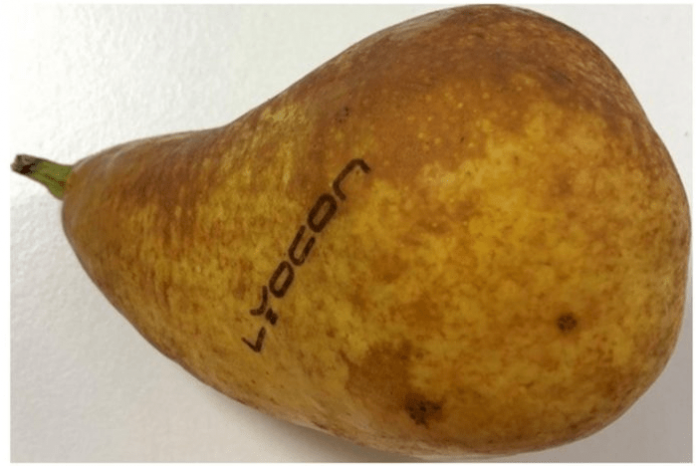
In the natural branding process, a laser controlled by a deflection unit removes the acme pigment layer of the natural skin of the food. Natural branding with light amplification by stimulated emission of radiation does not require any additional color and impregnates the desired lettering or company logo directly onto the food by ways of a focused light axle. Accomplished using a blue laser calorie-free organization in a cold marking process, it generates negligible estrus on the appurtenances. It also exhibits high absorption, skillful processing efficiency and depression energy output. The method is currently used on foods like garlic, onions, nuts, eggs, lemons, mangoes, or sweet potatoes. Already tried and tested abroad, the engineering has been in utilize in Australia since 2009. "Natural branding is hazard-gratuitous. Marking with a blue laser system that includes an opto-mechanical deflection unit offers many advantages including high reliability, long service life, minimal space requirements and a safe process. It also offers completely new possibilities for sustainable and resource-efficient marking," affirms Wolfgang Lehmann, product manager at Raylase.
With precise positioning and an accurate focus, the light amplification by stimulated emission of radiation beam can be adapted exactly to the shape of the nutrient. This prevents damage, premature spoilage and contamination of fruit and vegetables. At that place is also no loss of freshness, fragrance, gustatory modality, scent, or shelf life. And best of all, the energy required to mark the nutrient is less than 1% of the free energy needed to produce a conventional sticker, while CO two emissions for laser marking are less than 0.two% of those needed for a comparably sized sticker. "With natural branding, retailers can save literally tons of plastic used for organic food alone in Frg and significantly improve their CO 2 emissions," says Raylase CEO Dr Philipp Schön, commending the benefits of the state-of-the-art process.
Unfortunately, the list of cons cited past many supermarket bondage is notwithstanding long. For example, the need for packaging that ensures at that place is no confusion between organic products and conventional goods, and prevents pesticide residues from conventional products transferring onto organic goods. From the retailer'south signal of view, some form of protective packaging for nutrient simply seems ameliorate. However, with the motion towards regionalism in nutrient retail and growing consumer force per unit area, things are now changing. For example, in Bavaria eggs and basics are already often laser branded. "But and then much more is possible," says Dr. Schön, who is convinced, "because the limits of this procedure are fix but past the production. Provided the shell is not too thin or delicate, natural branding tin be applied anywhere with easy readability and clear dissimilarity definition. And food labelled this way is completely condom to consume."

Slowly but surely, a shift is happening. 'Laser labelling' is increasingly being discovered by well-known food producers, packaging manufacturers and supermarkets similar Edeka in Federal republic of germany, ICA in Sweden and One thousand&South in the Britain. Through natural branding, Edeka plans to save 50 tons in packaging material for fruit and vegetables, and Rewe and Aldi too aim to test suitability on further products.
Buying certified organic foods is no guarantee for environmentally friendly packaging. "But information technology makes sense that organic food production – if not to exist considered 'green washing' – should be followed as much every bit possible by resources-saving ecological packaging. In this respect, natural branding gives maximum credibility," stresses Harnesh Singh, responsible for Sales & Marketing at Raylase. Fugitive excessive plastic, paper, cellophane, or trays is also good news for consumers who desire to reduce their own carbon footprint and therefore consciously seek out the unpackaged goods.

So, the way ahead is clear for the new energy-saving star of the laser industry! The blue 450nm laser with 6-11W browse systems is set to brand its mark on the nutrient industry for organic products and more. "The blueish light amplification by stimulated emission of radiation lite in combination with our deflection units offers a safety, eco-friendly solution for all types of mark applications. The marketplace for 'natural branding' is bursting with opportunities," Dr Schön is in no uncertainty about that.
phelpsforgaziesing.blogspot.com
Source: https://packagingsouthasia.com/type-of-article/raylases-natural/
0 Response to "Raylase's natural branding & laser labelling of fresh produce"
Post a Comment