Los Angeles Times Old Review Page With Critics Comments
 | |
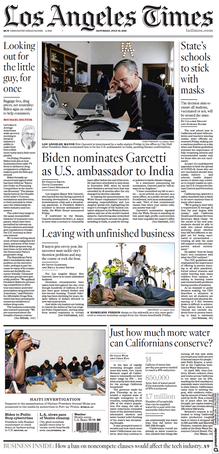 The July 10, 2021 forepart folio | |
| Type | Daily newspaper |
|---|---|
| Format | Broadsheet |
| Owner(s) | Los Angeles Times Communications LLC (Nant Majuscule) |
| Founder(south) | Nathan Cole Jr. and Thomas Gardiner |
| President | Dr. Patrick Soon-Shiong |
| Editor | Kevin Merida |
| Founded | December 4, 1881 (1881-12-04) (as Los Angeles Daily Times) |
| Linguistic communication | English |
| Headquarters | 2300 Eastward. Royal Highway El Segundo, California 90245 |
| State | United States |
| Apportionment | 653,868 Daily (2013) 954,010 Sunday (2013) 105,000 Digital (2018)[1] |
| ISSN | 0458-3035 (print) 2165-1736 (web) |
| OCLC number | 3638237 |
| Website | latimes |
| |
The Los Angeles Times (abbreviated as LA Times ) is a daily newspaper that started publishing in Los Angeles in 1881 and is now based in the next suburb of El Segundo.[2] Information technology has the fifth-largest circulation in the U.S. and is the largest American newspaper not headquartered on the Eastward Coast.[iii] The paper focuses its coverage of issues particularly salient to the Due west Coast, such equally immigration trends and natural disasters. It has won more than than 40 Pulitzer Prizes for its coverage of these and other bug. Every bit of June eighteen, 2018[update], buying of the paper is controlled past Patrick Shortly-Shiong, and the executive editor is Norman Pearlstine.[iv] It is considered a newspaper of record in the U.S.[5] [six]
In the 19th century, the paper adult a reputation for civic boosterism and opposition to labor unions, the latter of which led to the bombing of its headquarters in 1910. The paper'south profile grew substantially in the 1960s under publisher Otis Chandler, who adopted a more national focus. In contempo decades the paper's readership has declined, and it has been beset past a series of buying changes, staff reductions, and other controversies. In Jan 2018, the paper's staff voted to unionize and finalized their starting time union contract on October sixteen, 2019.[7] The paper moved out of its historic downtown headquarters to a facility in El Segundo, California near Los Angeles International Airport in July 2018.
History [edit]

Otis era [edit]
The Times was first published on December four, 1881, as the Los Angeles Daily Times under the direction of Nathan Cole Jr. and Thomas Gardiner. It was first printed at the Mirror printing constitute, owned by Jesse Yarnell and T. J. Caystile. Unable to pay the printing beak, Cole and Gardiner turned the paper over to the Mirror Company. In the meantime, S. J. Mathes had joined the firm, and it was at his insistence that the Times continued publication. In July 1882, Harrison Gray Otis moved from Santa Barbara to become the paper'due south editor.[viii] Otis made the Times a financial success.
Historian Kevin Starr wrote that Otis was a man of affairs "capable of manipulating the entire apparatus of politics and public opinion for his ain enrichment".[nine] Otis's editorial policy was based on borough boosterism, extolling the virtues of Los Angeles and promoting its growth. Toward those ends, the paper supported efforts to expand the city's water supply by acquiring the rights to the water supply of the afar Owens Valley.[10]

The efforts of the Times to fight local unions led to the bombing of its headquarters on October 1, 1910, killing 20-one people. Two union leaders, James and Joseph McNamara, were charged. The American Federation of Labor hired noted trial attorney Clarence Darrow to represent the brothers, who eventually pleaded guilty.
Otis attached a bronze hawkeye on top of a high frieze of the new Times headquarters building designed by Gordon Kaufmann, proclaiming anew the credo written by his married woman, Eliza: "Stand Fast, Stand Firm, Stand Sure, Stand True".[xi] [12]
Chandler era [edit]
After Otis's death in 1917, his son-in-law, Harry Chandler, took control every bit publisher of the Times. Harry Chandler was succeeded in 1944 by his son, Norman Chandler, who ran the newspaper during the rapid growth of mail-war Los Angeles. Norman's wife, Dorothy Buffum Chandler, became agile in civic diplomacy and led the endeavor to build the Los Angeles Music Center, whose principal concert hall was named the Dorothy Chandler Pavilion in her accolade. Family unit members are cached at the Hollywood Forever Cemetery near Paramount Studios. The site besides includes a memorial to the Times Edifice bombing victims.
In 1935, the newspaper moved to a new, landmark Art Deco building, the Los Angeles Times Building, to which the paper would add other facilities until taking upwardly the entire metropolis block between Bound, Broadway, First and Second streets, which came to be known as Times Mirror Square and would business firm the paper until 2018. Harry Chandler, then the president and full general managing director of Times-Mirror Co., alleged the Los Angeles Times Building a "monument to the progress of our city and Southern California".[13]
The fourth generation of family unit publishers, Otis Chandler, held that position from 1960 to 1980. Otis Chandler sought legitimacy and recognition for his family'due south newspaper, often forgotten in the ability centers of the Northeastern United states due to its geographic and cultural distance. He sought to remake the paper in the model of the nation's well-nigh respected newspapers, such as The New York Times and The Washington Mail. Assertive that the newsroom was "the heartbeat of the business",[14] Otis Chandler increased the size and pay of the reporting staff and expanded its national and international reporting. In 1962, the newspaper joined with The Washington Post to form the Los Angeles Times–Washington Post News Service to syndicate articles from both papers for other news organizations. He too toned down the unyielding conservatism that had characterized the newspaper over the years, adopting a much more centrist editorial stance.
During the 1960s, the paper won four Pulitzer Prizes, more than than its previous nine decades combined.
Writing in 2013 nearly the pattern of paper ownership past founding families, Times reporter Michael Hiltzik said that:
The beginning generations bought or founded their local paper for profits and also social and political influence (which often brought more profits). Their children enjoyed both profits and influence, but every bit the families grew larger, the afterwards generations plant that just one or two branches got the power, and everyone else got a share of the money. Eventually the coupon-clipping branches realized that they could brand more money investing in something other than newspapers. Under their pressure the companies went public, or split autonomously, or disappeared. That's the pattern followed over more than a century by the Los Angeles Times nether the Chandler family.[15]
The paper's early on history and subsequent transformation was chronicled in an unauthorized history, Thinking Big (1977, ISBN 0-399-11766-0), and was 1 of four organizations profiled by David Halberstam in The Powers That Exist (1979, ISBN 0-394-50381-three; 2000 reprint ISBN 0-252-06941-2). It has besides been the whole or partial subject area of nearly thirty dissertations in communications or social science in the past iv decades.[16]
Erstwhile Times buildings [edit]
-

The 1886 Times building, northeast corner 1st/Broadway -

Times 1886 building after bombing on Oct 1, 1910 -
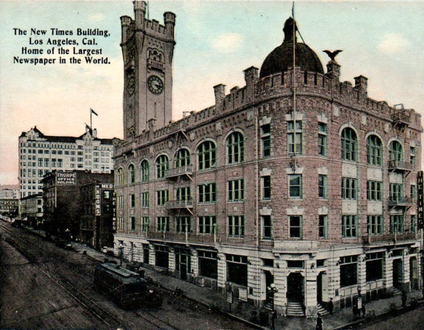
1912 Times building, demolished in 1938
-

Los Angeles Times Building, corner of 1st/Spring
-
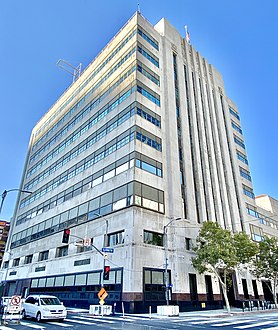
The 1948 Crawford Improver (or Mirror Building), NW corner 2d/Spring, 2020 -

1973 Pereira Addition, SE corner 1st/Broadway
- 1881-1886, Temple and New Loftier streets in the Los Angeles fundamental business commune[17]
- 1886-1910, northeast corner Kickoff and Broadway, Los Angeles fundamental business organization district, destroyed in a bombing in 1910[17]
- 1912-1935, northeast corner First and Broadway, rebuilt as a iv-story building with "castle-like" clock tower, opened 1912[17]
- 1935-2018, Times Mirror Foursquare, the cake divisional by Kickoff, Second, Spring streets and Broadway, Downtown Los Angeles
- 2018–present, El Segundo, California
Modernistic era [edit]
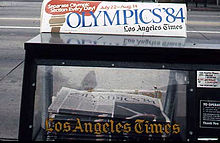
The Los Angeles Times was beset in the start decade of the 21st century past a change in ownership, a defalcation, a rapid succession of editors, reductions in staff, decreases in paid circulation, the need to increase its Web presence, and a series of controversies.
The paper moved to a new headquarters building in El Segundo, about Los Angeles International Airport, in July 2018.[eighteen] [19] [twenty] [21]
Ownership [edit]
In 2000, Times Mirror Company, publisher of the Los Angeles Times, was purchased by the Tribune Company of Chicago, Illinois, placing the paper in co-buying with the and so WB-affiliated (now CW-affiliated) KTLA, which Tribune acquired in 1985.[22]
On April ii, 2007, the Tribune Company announced its acceptance of real estate entrepreneur Sam Zell's offer to purchase the Chicago Tribune, the Los Angeles Times, and all other company assets. Zell announced that he would sell the Chicago Cubs baseball gild. He put up for sale the company'south 25 per centum involvement in Comcast SportsNet Chicago. Until shareholder approving was received, Los Angeles billionaires Ron Burkle and Eli Broad had the correct to submit a higher bid, in which case Zell would have received a $25 meg buyout fee.[23]
In Dec 2008, the Tribune Company filed for bankruptcy protection. The bankruptcy was a result of declining advertising revenue and a debt load of $12.9 billion, much of it incurred when the paper was taken private past Zell.[24]
On February seven, 2018, Tribune Publishing (formerly Tronc Inc.), agreed to sell the Los Angeles Times along with other southern California properties (The San Diego Union-Tribune, Hoy) to billionaire biotech investor Patrick Soon-Shiong.[25] [26] This purchase by Soon-Shiong through his Nant Capital investment fund was for $500 meg, every bit well as the supposition of $90 million in pension liabilities.[27] [28] The auction to Before long-Shiong closed on June sixteen, 2018.[4]
Editorial changes and staff reductions [edit]
In 2000, John Carroll, former editor of the Baltimore Lord's day, was brought in to restore the luster of the newspaper.[29] During his reign at the Times, he eliminated more than than 200 jobs, but despite an operating profit margin of xx percent, the Tribune executives were unsatisfied with returns, and by 2005 Carroll had left the newspaper. His successor, Dean Baquet, refused to impose the additional cutbacks mandated by the Tribune Visitor.
Baquet was the first African-American to concur this type of editorial position at a top-tier daily. During Baquet and Carroll's time at the newspaper, it won 13 Pulitzer Prizes, more than whatever other paper except The New York Times.[30] Still, Baquet was removed from the editorship for non meeting the demands of the Tribune Group—every bit was publisher Jeffrey Johnson—and was replaced by James O'Shea of the Chicago Tribune. O'Shea himself left in Jan 2008 afterward a budget dispute with publisher David Hiller.
The paper'due south content and blueprint style were overhauled several times in attempts to increase apportionment. In 2000, a major change reorganized the news sections (related news was put closer together) and changed the "Local" section to the "California" section with more extensive coverage. Another major change in 2005 saw the Lord's day "Opinion" section retitled the Dominicus "Current" section, with a radical change in its presentation and featured columnists. At that place were regular cross-promotions with Tribune-endemic television station KTLA to bring evening-news viewers into the Times fold.
The paper reported on July three, 2008, that it planned to cut 250 jobs by Labor Day and reduce the number of published pages by 15 percent.[31] [32] That included about 17 percent of the news staff, as part of the newly private media company's mandate to reduce costs. "Nosotros've tried to become ahead of all the change that's occurring in the business and get to an organisation and size that will be sustainable", Hiller said.[33] In January 2009, the Times eliminated the separate California/Metro section, folding it into the front section of the newspaper. The Times also announced lxx job cuts in news and editorial or a 10 percent cut in payroll.[34]
In September 2015, Austin Beutner, the publisher and primary executive, was replaced past Timothy E. Ryan.[35] On October v, 2015, the Poynter Institute reported that "'At least l' editorial positions volition exist culled from the Los Angeles Times" through a buyout.[36] On this subject field, the Los Angeles Times reported with foresight: "For the 'funemployed,' unemployment is welcome."[37] Nancy Cleeland,[38] who took O'Shea'southward buyout offering, did so because of "frustration with the paper'due south coverage of working people and organized labor"[39] (the beat that earned her Pulitzer).[38] She speculated that the paper'southward acquirement shortfall could be reversed by expanding coverage of economic justice topics, which she believed were increasingly relevant to Southern California; she cited the newspaper's attempted hiring of a "celebrity justice reporter" as an case of the wrong approach.[39]
On August 21, 2017, Ross Levinsohn, so aged 54, was named publisher and CEO, replacing Davan Maharaj, who had been both publisher and editor.[forty] On June 16, 2018, the aforementioned day the sale to Patrick Soon-Shiong closed, Norman Pearlstine was named executive editor.[4]
On May three, 2021, the newspaper appear that it had selected Kevin Merida to exist the new executive editor. Merida is a senior vice president at ESPN and leads The Undefeated, a site focused on sports, race, and culture. Previously, he was the first Black managing editor at The Washington Postal service.[41]
Circulation [edit]
The Times has suffered continued refuse in distribution. Reasons offered for the circulation drop included a price increase[42] and a rise in the proportion of readers preferring to read the online version instead of the print version.[43] Editor Jim O'Shea, in an internal memo announcing a May 2007, generally voluntary, reduction in forcefulness, characterized the decrease in circulation as an "industry-wide trouble" which the paper had to counter by "growing speedily on-line", "break[ing] news on the Spider web and explain[ing] and analyz[ing] it in our newspaper."[44]
The Times closed its San Fernando Valley printing plant in early on 2006, leaving printing operations to the Olympic plant and to Orange County. Also that twelvemonth the paper announced its apportionment had fallen to 851,532, downwardly five.4 percentage from 2005. The Times 's loss of circulation was the largest of the top ten newspapers in the U.Due south.[45] Some observers believed that the driblet was due to the retirement of circulation managing director Bert Tiffany. Still, others thought the decline was a side outcome of a succession of short-lived editors who were appointed past publisher Marking Willes later publisher Otis Chandler relinquished day-to-solar day control in 1995.[fourteen] Willes, the former president of Full general Mills, was criticized for his lack of understanding of the newspaper business concern, and was derisively referred to by reporters and editors as The Cereal Killer.[46]

Abandoned Los Angeles Times vending automobile in Covina, California, in 2011
The Times 'south reported daily circulation in Oct 2010 was 600,449,[47] down from a acme of 1,225,189 daily and 1,514,096 Sunday in April 1990.[48] [49]
Internet presence and free weeklies [edit]
In December 2006, a team of Times reporters delivered management with a critique of the newspaper's online news efforts known as the Jump Street Project.[50] The study, which condemned the Times as a "spider web-stupid" organization",[50] was followed past a shakeup in management of the paper's website,[51] www.latimes.com, and a rebuke of impress staffers who had assertedly "treated change as a threat."[52]
On July x, 2007, Times launched a local Metromix site targeting live entertainment for immature adults.[53] A free weekly tabloid print edition of Metromix Los Angeles followed in February 2008; the publication was the newspaper'due south first stand-alone print weekly.[54] In 2009, the Times shut down Metromix and replaced it with Brand X, a weblog site and gratuitous weekly tabloid targeting young, social networking readers.[55] Brand X launched in March 2009; the Brand Ten tabloid ceased publication in June 2011 and the website was close down the post-obit month.[56]
In May 2018, the Times blocked admission to its online edition from most of Europe because of the European Matrimony's Full general Data Protection Regulation.[57] [58]
Other controversies [edit]
It was revealed in 1999 that a revenue-sharing arrangement was in place between the Times and Staples Eye in the preparation of a 168-page magazine nearly the opening of the sports arena. The magazine's editors and writers were not informed of the agreement, which breached the Chinese wall that traditionally has separated advertizement from journalistic functions at American newspapers. Publisher Marker Willes also had not prevented advertisers from pressuring reporters in other sections of the newspaper to write stories favorable to their point of view.[59] Michael Kinsley was hired every bit the Opinion and Editorial (op-ed) Editor in April 2004 to aid ameliorate the quality of the opinion pieces. His function was controversial, for he forced writers to take a more decisive opinion on issues. In 2005, he created a Wikitorial, the first Wiki by a major news organization. Although it failed, readers could combine forces to produce their own editorial pieces. It was shut down after being besieged with inappropriate fabric. He resigned later that year.[60]
The Times drew fire for a terminal-minute story before the 2003 California call up election alleging that gubernatorial candidate Arnold Schwarzenegger groped scores of women during his picture show career. Columnist Jill Stewart wrote on the American Reporter website that the Times did not do a story on allegations that former Governor Gray Davis had verbally and physically abused women in his office, and that the Schwarzenegger story relied on a number of bearding sources. Further, she said, 4 of the half-dozen alleged victims were not named. She too said that in the case of the Davis allegations, the Times decided against press the Davis story because of its reliance on anonymous sources.[61] [62] The American Guild of Paper Editors said that the Times lost more than x,000 subscribers because of the negative publicity surrounding the Schwarzenegger commodity.[63]
On Nov 12, 2005, new op-ed Editor Andrés Martinez announced the dismissal of liberal op-ed columnist Robert Scheer and conservative editorial cartoonist Michael Ramirez.[64]
The Times too came under controversy for its decision to driblet the weekday edition of the Garfield comic strip in 2005, in favor of a hipper comic strip Brevity, while retaining the Lord's day edition. Garfield was dropped altogether presently thereafter.[65]
Following the Republican Party's defeat in the 2006 mid-term elections, an Opinion slice by Joshua Muravchik, a leading neoconservative and a resident scholar at the conservative American Enterprise Institute, published on November 19, 2006, was titled 'Bomb Islamic republic of iran'. The article shocked some readers, with its hawkish comments in support of more unilateral action past the United States, this time against Iran.[66]
On March 22, 2007, editorial folio editor Andrés Martinez resigned following an alleged scandal centering on his girlfriend's professional person relationship with a Hollywood producer who had been asked to invitee-edit a section in the paper.[67] In an open up letter of the alphabet written upon leaving the newspaper, Martinez criticized the publication for allowing the Chinese Wall betwixt the news and editorial departments to be weakened, accusing news staffers of lobbying the opinion desk.[68]
In November 2017, Walt Disney Studios blacklisted the Times from attending printing screenings of its films, in retaliation for September 2017 reportage by the paper on Disney's political influence in the Anaheim area. The company considered the coverage to exist "biased and inaccurate". As a sign of condemnation and solidarity, a number of major publications and writers, including The New York Times, Boston Globe critic Ty Burr, Washington Post blogger Alyssa Rosenberg, and the websites The A.V. Gild and Flavorwire, announced that they would boycott press screenings of hereafter Disney films. The National Social club of Picture Critics, Los Angeles Film Critics Association, New York Film Critics Circumvolve, and Boston Society of Film Critics jointly announced that Disney'due south films would exist ineligible for their respective twelvemonth-end awards unless the decision was reversed, condemning the decision every bit being "antonymous to the principles of a free press and [setting] a dangerous precedent in a time of already heightened hostility towards journalists". On November 7, 2017, Disney reversed its decision, stating that the company "had productive discussions with the newly installed leadership at the Los Angeles Times regarding our specific concerns".[69] [70] [71]
Pulitzer Prizes [edit]
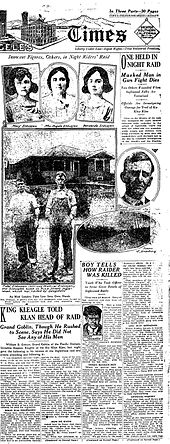
Through 2014 the Times had won 41 Pulitzer Prizes, including four in editorial cartooning, and one each in spot news reporting for the 1965 Watts Riots and the 1992 Los Angeles riots.[72]
- The Los Angeles Times received the 1984 Pulitzer Prize for Public Service for the newspaper series "Latinos".[73]
- Times sportswriter Jim Murray won a Pulitzer in 1990.
- Times investigative reporters Chuck Philips and Michael Hiltzik won the Pulitzer in 1999[74] for a year-long series that exposed corruption in the music business.[75]
- Times announcer David Willman won the 2001 Pulitzer Prize for Investigative Reporting; the organization cited "his pioneering betrayal of seven dangerous prescription drugs that had been approved by the Food and Drug Administration, and an analysis of the policy reforms that had reduced the bureau's effectiveness."[76] In 2004, the paper won five prizes, which is the third-near by any paper in 1 year (behind The New York Times in 2002 (seven) and The Washington Mail in 2008 (6)).
- Times reporters Bettina Boxall and Julie Cart won a Pulitzer Prize for Explanatory Reporting in 2009 "for their fresh and painstaking exploration into the price and effectiveness of attempts to combat the growing menace of wildfires across the western United States."[77]
- In 2011, Barbara Davidson was awarded the Pulitzer Prize for Characteristic Photography "for her intimate story of innocent victims trapped in the city'south crossfire of deadly gang violence."[78]
- In 2016, the Times won the breaking news Pulitzer prize for its coverage of the mass shooting in San Bernardino, California.[79]
- In 2019, three Los Angeles Times reporters - Harriet Ryan, Matt Hamilton and Paul Pringle - won a Pulitzer Prize for their investigation into a gynecologist defendant of abusing hundreds of students at the University of Southern California.[fourscore]
Contest and rivalry [edit]
In the 19th century, the chief contest to the Times was the Los Angeles Herald, followed past the smaller Los Angeles Tribune. In December 1903, newspaper magnate William Randolph Hearst began publishing the Los Angeles Examiner every bit a straight forenoon competitor to the Times. [81] In the 20th century, the Los Angeles Express was an afternoon competitor, as was Manchester Boddy's Los Angeles Daily News, a Democratic paper.[82]
By the mid-1940s, the Times was the leading newspaper in terms of circulation in the Los Angeles metropolitan expanse. In 1948, it launched the Los Angeles Mirror, an afternoon tabloid, to compete with both the Daily News and the merged Herald-Express. In 1954, the Mirror absorbed the Daily News. The combined paper, the Mirror-News, ceased publication in 1962, when the Hearst afternoon Herald-Limited and the morning Los Angeles Examiner merged to become the Herald-Examiner.[83] The Herald-Examiner published its terminal number in 1989. In 2014, the Los Angeles Register, published by Freedom Communications, then-parent company of the Orangish County Register was launched every bit a daily newspaper to compete with the Times. By late September of the aforementioned twelvemonth, the Los Angeles Register was folded.[84] [85]
Special editions [edit]
Midwinter and midsummer [edit]
Midwinter [edit]
For 69 years, from 1885[86] until 1954, the Times issued on New year's day's Mean solar day a special annual Midwinter Number or Midwinter Edition that extolled the virtues of Southern California. At first, it was called the "Merchandise Number," and in 1886 it featured a special press run of "extra telescopic and proportions"; that is, "a twenty-four-page paper, and we hope to brand information technology the finest exponent of this [Southern California] country that ever existed."[87] Ii years subsequently, the edition had grown to "forty-eight handsome pages (9x15 inches), [which] stitched for convenience and amend preservation," was "equivalent to a 150-page book."[88] The final utilise of the phrase Merchandise Number was in 1895, when the edition had grown to thirty-6 pages split up amid iii separate sections.[89]
The Midwinter Number drew acclamations from other newspapers, including this one from The Kansas City Star in 1923:
Information technology is made up of five magazines with a total of 240 pages – the maximum size possible nether the postal regulations. It goes into every detail of information about Los Angeles and Southern California that the eye could desire. Information technology is about a cyclopedia on the subject. It drips official statistics. In add-on, it verifies the statistics with a profusion of analogy. . . . it is a remarkable combination of guidebook and travel magazine.[90]
In 1948 the Midwinter Edition, as it was and then chosen, had grown to "7 big moving picture magazines in beautiful rotogravure reproduction."[91] The terminal mention of the Midwinter Edition was in a Times advertisement on January 10, 1954.[92]
Midsummer [edit]
Between 1891 and 1895, the Times too issued a similar Midsummer Number, the first one with the theme "The State and Its Fruits".[93] Because of its issue appointment in September, the edition was in 1891 chosen the Midsummer Harvest Number.[94]
Zoned editions and subsidiaries [edit]

Front page of the debut (March 25, 1903) outcome of the short-lived The Wireless, published in Avalon.[95]
In 1903, the Pacific Wireless Telegraph Company established a radiotelegraph link between the California mainland and Santa Catalina Isle. In the summer of that year, the Times made utilize of this link to establish a local daily paper, based in Avalon, chosen The Wireless, which featured local news plus excerpts which had been transmitted via Morse code from the parent paper.[96] However, this effort apparently survived for only a piddling more than than ane year.[97]
In the 1990s, the Times published various editions catering to far-flung areas. Editions included those from the San Fernando Valley, Ventura County, Inland Empire, Orange County, San Diego County & a "National Edition" that was distributed to Washington, D.C., and the San Francisco Bay Area. The National Edition was closed in December 2004.
Some of these editions[ quantify ] were succeeded past Our Times, a group of community supplements included in editions of the regular Los Angeles Metro paper.[ citation needed ]
A subsidiary, Times Community Newspapers, publishes the Daily Airplane pilot of Newport Embankment and Costa Mesa.[98] [99] From 2011 to 2013, the Times had published the Pasadena Sun.[100] It also had published the Glendale News-Press and Burbank Leader from 1993 to 2020, and the La Cañada Valley Lord's day from 2005 to 2020.[101]
On April 30, 2020, Charlie Plowman, publisher of Outlook Newspapers, announced he would acquire the Glendale News-Press, Burbank Leader and La Cañada Valley Dominicus from Times Community Newspapers. Plowman caused the South Pasadena Review and San Marino Tribune in late January 2020 from the Salter family, who endemic and operated these two customs weeklies.[ citation needed ]
Features [edit]
One of the Times ' features was "Cavalcade One", a feature that appeared daily on the front page to the left-paw side. Established in September 1968, information technology was a place for the weird and the interesting; in the How Far Tin a Pianoforte Fly? (a compilation of Column I stories) introduction, Patt Morrison wrote that the column's purpose was to elicit a "Gee, that's interesting, I didn't know that" type of reaction.
The Times also embarked on a number of investigative journalism pieces. A series in Dec 2004 on the King/Drew Medical Center in Los Angeles led to a Pulitzer Prize and a more thorough coverage of the hospital's troubled history. Lopez wrote a v-office series on the civic and humanitarian disgrace of Los Angeles' Slip Row, which became the focus of a 2009 move flick, The Soloist. It also won 62 awards at the SND[ clarification needed ] awards.
From 1967 to 1972, the Times produced a Sunday supplement called West magazine. West was recognized for its art blueprint, which was directed by Mike Salisbury (who later became art managing director of Rolling Stone magazine).[102] From 2000 to 2012, the Times published the Los Angeles Times Magazine, which started as a weekly then became a monthly supplement. The magazine focused on stories and photos of people, places, style, and other cultural affairs occurring in Los Angeles and its surrounding cities and communities. Since 2014, The California Sunday Magazine has been included in the Sunday L.A. Times edition.
Promotion [edit]
Festival of Books [edit]
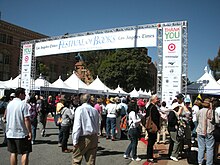
In 1996, the Times started the annual Los Angeles Times Festival of Books, in clan with the University of California, Los Angeles. Information technology has console discussions, exhibits, and stages during ii days at the end of April each yr.[103] In 2011, the Festival of Books was moved to the Academy of Southern California.[104]
Book prizes [edit]
Since 1980, the Times has awarded annual book prizes. The categories are at present biography, current involvement, fiction, commencement fiction, history, mystery/thriller, poetry, scientific discipline and applied science, and immature adult fiction. In addition, the Robert Kirsch Award is presented annually to a living author with a substantial connection to the American Due west whose contribution to American letters deserves special recognition".[105]
Los Angeles Times Grand Prix [edit]
From 1957 to 1987, the Times sponsored the Los Angeles Times Grand Prix that was held over at the Riverside International Raceway in Moreno Valley, California.
Other media [edit]
Volume publishing [edit]
The Times Mirror Corporation has also owned a number of book publishers over the years, including New American Library and C.V. Mosby, as well as Harry N. Abrams, Matthew Bender, and Jeppesen.[106]
In 1960, Times Mirror of Los Angeles bought the book publisher New American Library, known for publishing affordable paperback reprints of classics and other scholarly works.[107] The NAL continued to operate autonomously from New York and inside the Mirror Company. In 1983, Odyssey Partners and Ira J. Hechler bought NAL from the Times Mirror Company for over $l meg.[106]
In 1967, Times Mirror acquired C.5. Mosby Visitor, a professional publisher and merged information technology over the years with several other professional publishers including Resource Application, Inc., Year Book Medical Publishers, Wolfe Publishing Ltd., PSG Publishing Visitor, B.C. Decker, Inc., among others. Eventually in 1998 Mosby was sold to Harcourt Brace & Company to form the Elsevier Health Sciences group.[108]
Broadcasting activities [edit]
 | |
| Formerly | KTTV, Inc. (1947-1963) |
|---|---|
| Type | Individual |
| Manufacture | Broadcast television Media |
| Founded | December 1947 (1947-12) |
| Defunct | 1993 |
| Fate | Acquired by Argyle Television (sold to New World Communications in 1994) |
| Headquarters | Los Angeles, California United States |
| Area served |  U.s. U.s. |
| Products | Broadcast and cablevision television |
| Parent | The Times-Mirror Company (1947–1963, 1970–1993) Silent (1963–1970) |
The Times-Mirror Company was a founding owner of tv set station KTTV in Los Angeles, which opened in January 1949. It became that station'southward sole owner in 1951, later on re-acquiring the minority shares it had sold to CBS in 1948. Times-Mirror also purchased a former motion motion-picture show studio, Nassour Studios, in Hollywood in 1950, which was and then used to consolidate KTTV'south operations. Later to be known as Metromedia Square, the studio was sold forth with KTTV to Metromedia in 1963.
Afterwards a seven-yr hiatus from the medium, the firm reactivated Times-Mirror Broadcasting Company with its 1970 buy of the Dallas Times Herald and its radio and goggle box stations, KRLD-AM-FM-TV in Dallas.[109] The Federal Communications Commission granted an exemption of its cross-ownership policy and allowed Times-Mirror to retain the paper and the television outlet, which was renamed KDFW-Tv set.
Times-Mirror Broadcasting later caused KTBC-Boob tube in Austin, Texas in 1973;[110] and in 1980 purchased a group of stations endemic by Newhouse Newspapers: WAPI-TV (at present WVTM-Tv set) in Birmingham, Alabama; KTVI in St. Louis; WSYR-Idiot box (now WSTM-TV) in Syracuse, New York and its satellite station WSYE-Idiot box (now WETM-TV) in Elmira, New York; and WTPA-TV (now WHTM-TV) in Harrisburg, Pennsylvania.[111] The visitor also entered the field of cablevision television, servicing the Phoenix and San Diego areas, among others. They were originally titled Times-Mirror Cable, and were later renamed to Dimension Cablevision Television. Similarly, they as well attempted to enter the pay-TV market, with the Spotlight movie network; it wasn't successful and was rapidly shut down. The cable systems were sold in the mid-1990s to Cox Communications.
Times-Mirror also pared its station grouping downwards, selling off the Syracuse, Elmira and Harrisburg backdrop in 1986.[112] The remaining four outlets were packaged to a new upstart holding company, Argyle Television, in 1993.[113] These stations were acquired past New World Communications shortly thereafter and became key components in a sweeping shift of network-station affiliations which occurred betwixt 1994 and 1995.
Stations [edit]
| City of license / market | Station | Channel Tv set / (RF) | Years owned | Electric current ownership status |
|---|---|---|---|---|
| Birmingham | WVTM-Television | 13 (13) | 1980–1993 | NBC affiliate owned past Hearst Television |
| Los Angeles | KTTV 1 | xi (11) | 1949–1963 | Play a joke on owned-and-operated (O&O) |
| St. Louis | KTVI | 2 (43) | 1980–1993 | Fox affiliate owned by Nexstar Media Group |
| Elmira, New York | WETM-Tv | eighteen (18) | 1980–1986 | NBC affiliate endemic past Nexstar Media Grouping |
| Syracuse, New York | WSTM-TV | three (24) | 1980–1986 | NBC chapter owned past Sinclair Broadcast Group |
| Harrisburg - Lancaster - Lebanon - York | WHTM-TV | 27 (10) | 1980–1986 | ABC affiliate owned past Nexstar Media Group |
| Austin, Texas | KTBC-Telly | 7 (seven) | 1973–1993 | Fob owned-and-operated (O&O) |
| Dallas - Fort Worth | KDFW-Boob tube two | 4 (35) | 1970–1993 | Pull a fast one on owned-and-operated (O&O) |
Notes:
- one Co-owned with CBS until 1951 in a joint venture (51% owned by Times-Mirror, 49% endemic past CBS);
- 2 Purchased along with KRLD-AM-FM as part of Times-Mirror'due south acquisition of the Dallas Times Herald. Times-Mirror sold the radio stations to comply with FCC cantankerous-ownership restrictions.
Employees [edit]
Unionization [edit]
On January 19, 2018, employees of the news department voted 248–44 in a National Labor Relations Board election to be represented by the NewsGuild-CWA.[114] The vote came despite aggressive opposition from the paper'southward management squad, reversing more than a century of anti-union sentiment at one of the biggest newspapers in the state.
Writers and editors [edit]
- Dean Baquet, editor 2000–2007
- Martin Businesswoman, assistant managing editor 1979–1996
- James Bassett, reporter, editor 1934–1971
- Skip Bayless, sportswriter 1976–1978
- Barry Bearak, reporter 1982–1997
- Jim Bellows (1922–2005), editor 1967–1974
- Sheila Benson, film critic 1981–1991
- Martin Bernheimer, music critic, 1982 Pulitzer Prize for Criticism
- Bettina Boxall, reporter, 2009 Pulitzer Prize
- Jeff Brazil, reporter 1993–2000
- Harry Carr (1877–1936), reporter, columnist, editor
- John Carroll, editor 2000–2005
- Julie Cart, reporter, 2009 Pulitzer Prize
- Charles Champlin (1926–2014), film critic 1965–1980
- Sewell Chan, editor of the editorial page
- Michael Cieply, entertainment writer
- Shelby Coffey Three, editor 1989–1997
- One thousand.C. Cole, science writer
- Michael Connelly, criminal offence reporter, novelist
- Borzou Daragahi, Beirut bureau primary
- Manohla Dargis, motion picture critic
- Meghan Daum, columnist
- Anthony Day (1933–2007), op-ed writer, editor 1969–89
- Frank del Olmo (1948–2004), reporter, editor 1970–2004
- Al Delugach (1925–2015), reporter 1970–1989
- Barbara Demick, Beijing bureau principal, author
- Robert J. Donovan (1912–2003), Washington bureau chief
- Mike Downey, columnist 1985–2001
- Bob Drogin, national political reporter
- Roscoe Drummond (1902–1983), syndicated columnist
- E.Five. Durling (1893–1957), columnist 1936–1939
- Bill Dwyre, sports editor and columnist 1981–2015
- Braven Dyer, sports reporter, sports editor 1925-1965
- Louis Dyer, reporter, editor LA Mirror, Domicile Magazine 1934-1955
- William J. Eaton (1930–2005), contributor 1984–1994
- Richard Eder (1932–2014), book critic, 1987 Pulitzer Prize for Criticism
- Gordon Edes, sportswriter 1980–1989
- Helene Elliott, sports columnist
- Leonard Plume (1914–1994), jazz critic
- Dexter Filkins, foreign correspondent 1996–1999
- Nikki Finke, entertainment reporter
- Thomas Francis Ford (1873–1958), U.Southward. Congress fellow member, literary and rotogravure editor, Metropolis Council member
- Douglas Frantz, managing editor 2005–2007
- Jeffrey Gettleman, Atlanta bureau chief 1999–2002
- Jonathan Gold, food writer, 2007 Pulitzer Prize
- Patrick Goldstein, picture show columnist 2000–2012
- Carl Greenberg (1908–1984), political writer
- Jean Guerrero, opinion columnist
- Joyce Haber, gossip columnist 1966–1975
- Nib Henry (1890–1970), columnist 1939–1970
- Robert Hilburn, music author 1970–2005
- Shani Olisa Hilton, Deputy Managing editor
- Michael Hiltzik, investigative reporter, 1999 Pulitzer Prize for Trounce Reporting
- Hedda Hopper (1885–1966), Hollywood columnist 1938–1966
- L. D. Hotchkiss (1893–1964), editor 1922–1958
- Pete Johnson, stone critic of the 1960s
- David Cay Johnston, reporter 1976–1988
- Jonathan Kaiman, Asia contributor 2015-2016
- K. Connie Kang (1942–2019) first female person Korean American announcer
- Philip P. Kerby, 1976 Pulitzer Prize for Criticism
- Ann Killion, sportswriter 1987–1988
- Grace Kingsley (1874–1962), picture columnist 1914–1933
- Michael Kinsley, op-ed folio editor 2004–2005
- Christopher Knight, fine art critic, 2020 Pulitzer Prize for Criticism
- William Knoedelseder, business organisation writer
- Howard Lachtman, literary critic[115] [116]
- David Lamb (1940–2016), correspondent 1970–2004
- David Laventhol (1933–2015), publisher 1989–1994
- David Lazarus, business columnist
- Rick Loomis, photojournalist, 2007 Pulitzer Prize for Explanatory Reporting
- Stuart Loory (1937–2015), White Business firm correspondent 1967–1971
- Steve Lopez, columnist
- Charles Fletcher Lummis (1859–1928), city editor 1884–1888
- Al Martinez (1929–2015), columnist 1984–2009
- Andres Martinez, op-ed page editor 2004–2007
- Dennis McDougal, reporter 1982–1992
- Usha Lee McFarling, reporter, 2007 Pulitzer Prize for Explanatory Reporting
- Kristine McKenna, music journalist 1977–1998
- Mary McNamara, TV critic, 2015 Pulitzer Prize for Criticism
- Doyle McManus, Washington bureau chief
- Charles McNulty, theater critic
- Alan Miller, 2003 Pulitzer Prize for National Reporting
- T. Christian Miller, investigative journalist 1999–2008
- Kay Mills, editorial writer 1978–1991
- Carolina Miranda, arts and culture critic 2014–present
- J.R. Moehringer, feature writing, 2000 Pulitzer Prize for Characteristic Writing
- Patt Morrison, columnist
- Suzanne Muchnic, art critic 1978–2009
- Kim Irish potato, assistant managing editor for strange and national news, 2005 Pulitzer Prize
- Jim Murray (1919–1998), sports columnist, 1990 Pulitzer Prize for Commentary
- Sonia Nazario, characteristic writing, 2003 Pulitzer Prize
- Dan Neil, columnist, 2004 Pulitzer Prize for Criticism
- Chuck Neubauer, investigative journalist
- Ross Newhan, baseball author 1967–2004
- Jack Nelson (1929–2009), political reporter, 1960 Pulitzer Prize for Local Reporting[117]
- Anne-Marie O'Connor, reporter
- Nicolai Ouroussoff, architectural critic
- Scot J. Paltrow, financial journalist 1988–1997
- Olive Percival, columnist
- Nib Plaschke, sports columnist
- Michael Parks, foreign correspondent, editor, 1987 Pulitzer Prize for International Reporting
- Russ Parsons, food writer
- Mike Penner (1957–2009) (Christine Daniels), sportswriter
- Chuck Philips, investigative reporter, 1999 Pulitzer Prize for Beat Reporting
- Michael Phillips, flick critic
- George Ramos (1947–2011), reporter 1978–2003
- Richard Read, reporter, 1999 Pulitzer Prize 2001 Pulitzer Prize
- Ruth Reichl, restaurant and food writer 1984–1993
- Rick Reilly, sportswriter 1983–1985
- James Risen, investigative journalist 1984–1998
- Howard Rosenberg, Tv critic, 1985 Pulitzer Prize for Criticism
- Tim Rutten, columnist 1971–2011
- Harriet Ryan, Pulitzer Prize-winning investigative reporter
- Ruth Ryon (1944–2014), real estate writer 1977–2008
- Morrie Ryskind, feature author 1960–1971
- Kevin Sack, Pulitzer Prize for National Reporting in 2003
- Ruben Salazar (1928–1970), reporter, contributor 1959–70
- Robert Scheer, national correspondent 1976–1993
- Lee Shippey (1884–1969), columnist 1927–1949
- David Shaw (1943–2005), 1991 Pulitzer Prize for Criticism
- Gaylord Shaw, reporter, 1978 Pulitzer Prize
- Cistron Sherman (1915–1969), reporter, 1960 Pulitzer Prize
- Barry Siegel, feature writing, 2002 Pulitzer Prize
- T. J. Simers, sports columnist 1990–2013
- Jack Smith (1916–1996), columnist 1953–1996
- Bob Sipchen, editorial writing, 2002 Pulitzer Prize
- Frank Sotomayor, reporter, editor
- Bill Stall (1937–2008), editorial writing, 2004 Pulitzer Prize
- Joel Stein, columnist
- Jill Stewart, reporter 1984–1991
- Rone Tempest, investigative reporter 1976–2007
- Kevin Thomas, film critic 1962–2005
- William F. Thomas (1924–2014), editor 1971–1989
- Hector Tobar, columnist, book critic
- William Tuohy (1926–2009), foreign contributor, 1969 Pulitzer Prize for International Reporting
- Kenneth Turan, moving-picture show critic
- Julia Turner, deputy managing editor
- Peter Wallsten, national political reporter
- Matt Weinstock (1903–1970), columnist
- Kenneth R. Weiss, 2007 Pulitzer Prize for Explanatory Reporting
- Nick Williams (1906–1992), editor 1958–1971
- David Willman, 2001 Pulitzer Prize for Investigative Reporting
- Michael Wines, correspondent 1984–1988
- Jules Witcover, Washington correspondent 1970–1972
- Gene Wojciechowski, sportswriter 1986–1996
- Willard Huntington Wright (1888–1939), literary editor
- Kimi Yoshino, managing editor
Cartoonists [edit]
- Paul Francis Conrad (1924–2010), Pulitzer Prize in 1964, 1971, and 1984
- Ted Rall
- David Horsey, Pulitzer Prize in 1999 and 2003
- Frank Interlandi (1924–2010)
- Michael Patrick Ramirez, Pulitzer Prize in 1994 and 2008
- Bruce Russell, Pulitzer Prize in 1946
Photographers [edit]
- Don Bartletti, Pulitzer Prize in 2003
- Carolyn Cole, Pulitzer Prize in 2004
- Rick Corrales (1957–2005), photographer 1981–1995
- Mary Nogueras Frampton, one of the paper'southward beginning female photographers
- Jose Galvez, photographer 1980–1992
- John Fifty. Gaunt, Jr., Pulitzer Prize in 1955
- Rick Loomis, photojournalist, 2007 Pulitzer Prize
- Anacleto Rapping, multiple Pulitzer Prizes
- George Rose, photojournalist 1977–1983
- George Strock, photojournalist of the 1930s
- Annie Wells, photojournalist 1997–2008
- Clarence Williams, Pulitzer Prize in 1998
See also [edit]
- Victorian Downtown Los Angeles
References [edit]
- ^ "Total Circ for U.s.a. Newspapers". Archived from the original on June 11, 2013. Retrieved October 21, 2015.
{{cite web}}: CS1 maint: bot: original URL status unknown (link) - ^ "Los Angeles Times | History, Buying, & Facts". Encyclopedia Britannica . Retrieved October 1, 2020.
- ^ "The x Most Pop Daily Newspapers In The The states". August 2017. Retrieved October 24, 2017.
- ^ a b c Arango, Tim (June 18, 2018). "Norman Pearlstine Named Editor of The Los Angeles Times". The New York Times . Retrieved June eighteen, 2018.
- ^ Corey Frost; Karen Weingarten; Doug Babington; Don LePan; Maureen Okun (May thirty, 2017). The Broadview Guide to Writing: A Handbook for Students (6th ed.). Broadview Press. pp. 27–. ISBN978-i-55481-313-1 . Retrieved January 12, 2021.
- ^ Caulfield, Mike (Jan viii, 2017), "National Newspapers of Tape", Web Literacy for Student Fact-Checkers, Self-published, retrieved July 20, 2020
- ^ "Los Angeles Times reaches historic agreement with its newsroom union". Los Angeles Times. October 17, 2019. Retrieved November 15, 2019.
- ^ "Mirror Acorn, 'Times' Oak," Los Angeles Times, October 23, 1923, folio II-1 Access to this link requires the employ of a library card.
- ^ Starr, Kevin (1985). Inventing the Dream: California Through the Progressive Era . New York: Oxford University Press. p. 228. ISBN0-19-503489-ix. OCLC 11089240.
- ^ Arango, Tim; Nagourney, Adam (January xxx, 2018). "A Paper Tears Apart in a Urban center That Never Quite Came Together". The New York Times. ISSN 0362-4331. Retrieved April 3, 2019.
- ^ Berges, Marshall. The Life and Times of Los Angeles: A Newspaper, A Family unit and A City. New York: Atheneum. p. 25.
- ^ Clarence Darrow: Biography and Much More from Answers.com at world wide web.answers.com
- ^ DiMassa, Cara Mia (June 26, 2008). "Much has inverse effectually the Los Angeles Times Edifice". Los Angeles Times . Retrieved June 26, 2008.
- ^ a b McDougal, Dennis (2002). Privileged Son: Otis Chandler and the Ascent and Fall of the L.A. Times Dynasty. Cambridge, MA: Da Capo. ISBN0-306-81161-8. OCLC 49594139.
- ^ Hiltzik, Michael (Baronial 6, 2013). "Washington Post Buy: Can Jeff Bezos Set up Newspapers' Business Model?". Los Angeles Times . Retrieved October vi, 2014.
- ^ ProQuest Dissertation Abstracts. Retrieved June eight, 2007.
- ^ a b c Los Angeles Times Edifice, Water and Ability Assembly
- ^ Chang, Andrea (April 17, 2018). "L.A. Times will move to 2300 E. Royal Highway in El Segundo". Los Angeles Times . Retrieved July 19, 2018.
- ^ "Biotech billionaire takes command of the LA Times, names new executive editor". Orangish County Register. Associated Printing. June 18, 2018. Retrieved July 19, 2018.
- ^ Curwen, Thomas (July 20, 2018). "For a cursory, shining moment, Times Mirror Square was L.A.'s Camelot". Los Angeles Times . Retrieved July 21, 2018.
- ^ Miranda, Carolina (July 17, 2018). "Ugly carpets and light-green marble: The pattern of the Los Angeles Times buildings changed along with the city, though not always gracefully". Los Angeles Times . Retrieved July 21, 2018.
- ^ "Tribune called on to sell Fifty.A. Times". CNN. September 18, 2006. Retrieved June 19, 2012.
- ^ "Tribune goes to Zell". Chicago Sun-Times. April three, 2007. Archived from the original on September eighteen, 2008.
- ^ James Rainey & Michael A. Hiltzik (Dec 9, 2008). "Owner of L.A. Times files for bankruptcy". Los Angeles Times.
- ^ Koren, Meg James, James Rufus (February 7, 2018). "Billionaire Patrick Soon-Shiong reaches bargain to buy Fifty.A. Times and San Diego Union-Tribune". Los Angeles Times . Retrieved Feb 8, 2018.
- ^ "Tronc in Talks to Sell Flagship Los Angeles Times to Billionaire Investor". February vi, 2018. Retrieved February 6, 2018.
- ^ "Tronc Pushes Into Digital Future Afterward Los Angeles Times Sale". February 7, 2018. Retrieved Feb vii, 2018.
- ^ James, Meg; Chang, Andrea (April thirteen, 2018). "Patrick Presently-Shiong plans to move Los Angeles Times to new campus in El Segundo". Los Angeles Times . Retrieved April 13, 2018.
- ^ "John Carroll, former Baltimore Sun and Los Angeles Times editor, dies at 73". TheGuardian.com. June 14, 2015.
- ^ Pappu, Sridhar (March–Apr 2007). "Reckless Condone: Dean Baquet on the gutting of the Los Angeles Times". Mother Jones.
- ^ Hiltzik, Michael A. (July iii, 2008). "Los Angeles Times to cut 250 jobs, including 150 from news staff: The newspaper cites falling advertising revenue in economical slowdown". Los Angeles Times.
- ^ Politi, Daniel (July 3, 2008). "Today'south Papers: "You Take Been Liberated"". Slate.
- ^ Shiva Ovide (July 3, 2008). "Los Angeles Times to Cutting Staff". The New York Times . Retrieved July 17, 2020.
- ^ Roderick, Kevin (January xxx, 2009). "Los Angeles Times kills local news section". LA Observed. Retrieved Baronial eight, 2016.
- ^ Somaiya, Ravi (September 8, 2015). "Austin Beutner Ousted as Los Angeles Times Publisher". The New York Times.
- ^ Mullin, Benjamin (Oct 5, 2015). "Tribune Publishing CEO announces buyouts". Poynter. Archived from the original on December 8, 2015. Retrieved Baronial 8, 2016.
- ^ "For the 'funemployed,' unemployment is welcome". LA Times. June 4, 2009. Retrieved Baronial eight, 2016.
- ^ a b East&P Staff (May 28, 2007). "Pulitzer Winner Explains Why She Took '50.A. Times' Buyout". Editor & Publisher. Nielsen Business organization Media, Inc. Retrieved May 28, 2007.
- ^ a b Cleeland, Nancy (May 28, 2007). "Why I'm Leaving The L.A. Times". Huffington Post.
- ^ James, Meg (August 21, 2017). "Ross Levinsohn is named the new publisher and CEO of the L.A. Times as height editors are ousted". Retrieved Baronial 21, 2017.
- ^ Robertson, Katie (May 3, 2021). "Los Angeles Times Hires Its Adjacent Height Editor: Kevin Merida, of ESPN". The New York Times . Retrieved May iii, 2021.
- ^ Shah, Diane, "The New Los Angeles Times" Columbia Journalism Review 2002, iii.
- ^ Rainey, James, "Paper Circulation Continues to Fall," Los Angeles Times May 1, 2007: D1.
- ^ E&P Staff (May 25, 2007). "California Dissever: 57 More Job Cuts at 'L.A. Times'". Editor & Publisher. Nielsen Business Media, Inc. Retrieved May 28, 2007.
- ^ Lieberman, David (May 9, 2006). "Newspaper sales dip, but websites proceeds". The states Today.
- ^ Shaw, David. "Crossing the Line". Los Angeles Times. Archived from the original on Oct 24, 2015. Retrieved Oct 3, 2016.
- ^ Nib Cromwell (April 26, 2010). "Similar Newspaper Revenue, the Refuse in Circ Shows Signs of Slowing". editorandpublisher.com. Archived from the original on October 27, 2010. Retrieved April 26, 2010.
- ^ "The Los Angeles Times' history". Los Angeles Times. ISSN 0458-3035. Retrieved May 15, 2017.
- ^ Equally told to RJ Smith. "Ripped from the headlines - Los Angeles Mag". Lamag.com. Retrieved Jan 12, 2009.
- ^ a b Saar, Mayrav (January 26, 2007). "LAT's Scathing Internal Memo. Read It Here". FishbowlLA. mediabistro.com. Archived from the original on October 30, 2007.
- ^ Roderick, Kevin (Jan 24, 2007). "Times retools on web — again". LA Observed.
- ^ Welch, Matt (January 24, 2007). "Jump Street Project unveiled!". Los Angeles Times.
- ^ "Metromix Makes Cool Debut". Los Angeles Times. July ten, 2007. Retrieved October 3, 2013.
- ^ Ives, Nate (February 13, 2008). "Los Angeles Times Launches Gratis Weekly". Advertising Age. Retrieved Oct 3, 2013.
- ^ "Editor announces weekly tabloid aimed at social-networking readers". Los Angeles Times. March 25, 2009. Retrieved October 3, 2013.
- ^ Roderick, Kevin (June 29, 2011). "50.A. Times folds Brand 10". LA Observed. Retrieved October 3, 2013.
- ^ Petroff, Alanna. "LA Times takes down website in Europe as privacy rules bite". CNN.
- ^ Newcomb, Alyssa (May 25, 2018). "Chicago Tribune, Los Angeles Times block European users due to GDPR". CBS News. NBC Universal. Retrieved June viii, 2018.
- ^ Elder, Sean (November 5, 1999). "Meltdown at the L.A. Times". Salon.com . Retrieved March 26, 2007.
- ^ Naughton, Philippe (June 21, 2005). "Foul language forces LA Times to pull plug on 'wikitorial'". The Times . Retrieved October 12, 2020.
- ^ Stewart, Jill (October xiv, 2003). "How the Los Angeles Times Really Decided to Publish its Accounts of Women Who Said They Were Groped". jillstewart.net. Archived from the original on February ane, 2008.
- ^ Cohn, Gary; Hall, Carla; Welkos, Robert W. (October 2, 2003). "Women Say Schwarzenegger Groped, Humiliated Them". Los Angeles Times. [ dead link ] Alt URL
- ^ "ASNE recognizes Los Angeles Times editor for leadership". ASNE.org. American Society of Newspaper Editors. March 24, 2004. Archived from the original on Nov xv, 2007.
- ^ "LA Times Fires Longtime Progressive Columnist Robert Scheer". Commonwealth Now! . Retrieved October 15, 2018.
- ^ Astor, Dave (January 5, 2005). "'L.A. Times' Drops Daily 'Garfield' every bit the Comic Is Blasted and Praised". Editor & Publisher. Nielsen Business Media, Inc. Archived from the original on September 19, 2008. Retrieved March 26, 2007. Alt URL
- ^ Muravchik, Joshua (November 19, 2006). "Bomb Iran". Los Angeles Times . Retrieved March 26, 2007.
- ^ Rainey, James (March 22, 2007). "Editor Resigns over Killed Opinion Section". Los Angeles Times. Archived from the original on March 25, 2007. Retrieved March 26, 2007.
- ^ Martinez, Andrés (March 22, 2007). "Grazergate, an Epilogue". Los Angeles Times . Retrieved March 26, 2007.
- ^ Carroll, Rory (November 7, 2017). "Disney's coma of LA Times triggers boycott from media outlets". The Guardian. ISSN 0261-3077. Retrieved November vii, 2017.
- ^ "Why I won't exist reviewing 'The Last Jedi,' or any other Disney picture show, in advance". The Washington Mail service . Retrieved November 7, 2017.
- ^ Carroll, Rory (Nov vii, 2017). "Disney ends coma of LA Times after boycott from media outlets". The Guardian. ISSN 0261-3077. Retrieved November 7, 2017.
- ^ "Los Angeles Times – Media Center". Los Angeles Times. Jan 17, 1994. Retrieved Jan 12, 2009.
- ^ "The 1984 Pulitzer Prize Winner in Public Service". The Pulitzer Prizes. Retrieved July 22, 2018.
- ^ "1999 Pulitzer Prize winners for trounce reporting". Columbia journalism review. Retrieved May 29, 2012.
- ^ Shaw, David (April xiii, 1999). "2 Times Staffers Share Pulitzer for Beat Reporting". Los Angeles Times . Retrieved July 30, 2012.
- ^ "The Pulitzer Prizes | Biography". Pulitzer.org. Oct 18, 1956. Retrieved August sixteen, 2010.
- ^ "2009 Pulitzer Prizes: Journalism". Reuters. April xx, 2009. Archived from the original on April 24, 2009. Retrieved October 6, 2014.
- ^ "The Pulitzer Prizes | Citation". www.pulitzer.org . Retrieved Nov 13, 2015.
- ^ Goffard, Christopher (April xviii, 2016). "Los Angeles Times wins Pulitzer for San Bernardino terrorist attack coverage". Los Angeles Times. Archived from the original on Jan xvi, 2020.
- ^ "Los Angeles Times". April fifteen, 2019. Retrieved April 17, 2016.
- ^ "December 1903: Hearst's Examiner comes to Fifty.A". Ulwaf.com. Retrieved October 21, 2012.
- ^ Red Ink, White Lies: The Rise and Autumn of Los Angeles Newspapers, 1920–1962 by Rob Leicester Wagner, Dragonflyer Printing, 2000.
- ^ Leonard Pitt and Dale Pitt, Los Angeles: A to Z, University of California Press, ISBN 0-520-20274-0.
- ^ "Los Angeles Register newspaper ends publication, five months later on launch". Reuters. September 23, 2014. Retrieved November 8, 2019.
- ^ "Los Angeles Annals to launch as new daily paper". Orange Canton Annals. December 13, 2013. Retrieved November 8, 2019.
- ^ "Harrison Gray Otis Southern California Historical Society". Socalhistory.org. May 25, 2016. Archived from the original on October 2, 2015. Retrieved August eight, 2016.
- ^ "Our Annual Trade Number," Los Angeles Times, December 18, 1886, page iv Access to this link requires the use of a library menu.
- ^ "Our Annual Edition," Los Angeles Times, December 21, 1888, folio iv Access to this link requires the use of a library menu.
- ^ "General Contents," Los Angeles Times, January 1, 1895 Access to this link requires the utilize of a library card.
- ^ Quoted in "Highest Praise Given to 'Times,'" Los Angeles Times, January 28, 1923, page 2-12 Access to this link requires the use of a library card.
- ^ Display advertisement, Los Angeles Times, December thirteen, 1947 Admission to this link requires the use of a library card.
- ^ "Bigger and Improve Than Ever," folio F-10 Access to this link requires the use of a library card.
- ^ "'The Land and Its Fruits' — Our Harvest Number," Los Angeles Times, September 5, 1891, page half-dozen Access to this link requires the utilise of a library carte du jour.
- ^ "Prepare Tomorrow," Los Angeles Times, September four, 1891, page 4 Admission to this link requires the utilize of a library card.
- ^ The 4 pages of the debut March 25, 1903, issue of The Wireless were reproduced on page 11 of the March 27, 1903, Times.
- ^ "The Wireless Daily Achieved" by C. E. Howell, The Independent, October 15, 1903, pages 2436-2440.
- ^ "Wireless Newspaper, Avalon, Santa Catalina Island" (islapedia.com)
- ^ "Los Angeles Times website". Los Angeles Times. April 17, 2014. Archived from the original on Baronial 26, 2009. Retrieved October six, 2014.
- ^ "Los Angeles Times Community Newspapers Add New Championship, Increase Coverage and Circulation with Dominicus News-Printing & Leader". Los Angeles Times. Jan 12, 2011.
Los Angeles Times Customs Newspapers (TCN) include the Huntington Beach Independent, Daily Pilot (Costa Mesa, Newport and Irvine) and Laguna Beach Coastline Pilot. TCN newspapers maintain separate editorial and business organization staffs from that of The Times, and focus exclusively on in-depth local coverage of their respective communities.
- ^ "The Pasadena Sun Publishes Last Issue". Editor & Publisher. July ane, 2013.
- ^ "A Note to Our Readers". April 17, 2020. Retrieved April 17, 2020.
- ^ Heller, Steven. "Go West, Young Art Director," Design Observer (Sept. 23, 2008).
- ^ "Los Angeles Times Festival of Books". Retrieved Oct six, 2014.
- ^ Rebecca Buddingh (September 26, 2010). "L.A. Times off-white comes to USC". Daily Trojan. University of Southern California. Retrieved October 21, 2012.
- ^ "Los Angeles Times Book Prizes home folio". Retrieved October vi, 2014.
- ^ a b McDowell, Edwin (August 11, 1983). "Times Mirror is Selling New American Library". The New York Times . Retrieved October 3, 2015.
- ^ Korda, Michael (1999). Some other life: a memoir of other people (1st ed.). New York: Random House. p. 103. ISBN0679456597.
- ^ "Mosby Company History". Elsevier. Retrieved Oct 3, 2015.
- ^ Storch, Charles (June 27, 1986). "Times Mirror Selling Dallas Times Herald". Chicago Tribune . Retrieved June 26, 2012.
- ^ "Johnson family sells Austin TV." Dissemination, September iv, 1972, pg. vi.
- ^ "Times Mirror'due south deal for Newhouse's TVs gets FCC blessing." Broadcasting, March 31, 1980, pg. 30.
- ^ "Irresolute hands: Proposed." Dissemination, September 30, 1985, pg. 109.
- ^ "Times Mirror fix to sell 4 Television set'." Archived June 9, 2015, at WebCite Dissemination and Cable, March 22, 1993, pg. vii.
- ^ Ember, Sydney (2018). "Wedlock Is Formed at Los Angeles Times and Publisher Put on Leave". The New York Times. ISSN 0362-4331. Retrieved January 20, 2018.
- ^ Lachtman, Howard (November seven, 1976). "Fantasy Fiction by Jack London". Los Angeles Times. p. 225. Retrieved January 28, 2022.
- ^ Lachtman, Howard (November 29, 1981). "West View". Los Angeles Times. p. 206. Retrieved January 28, 2022.
- ^ 1960 Winners, The Pulitzer Prizes
Further reading [edit]
- Ainsworth, Edward Maddin (c. 1940). History of Los Angeles Times.
- Berges, Marshall (1984). The life and Times of Los Angeles: A newspaper, a family, and a urban center. New York: Atheneum. ISBN0689114273.
- Gottlieb, Robert; Wolt, Irene (1977). Thinking large: the story of the Los Angeles Times, its publishers, and their influence on Southern California . New York: Putnam.
- Halberstam, David (1979). The Powers That Be . New York: Knopf. ISBN0394503813.
- Hart, Jack R. (1981). The information empire: The rise of the Los Angeles Times and the Times Mirror Corporation. Washington, D.C.: University Press of America. ISBN0819115800.
- Merrill, John C. and Harold A. Fisher. The world'south nifty dailies: profiles of fifty newspapers (1980) pp 183–91
- Prochnau, William (January–February 2000). "The Country of The American Newspaper: Down and Out in 50.A." American Journalism Review. College Park: University of Maryland Foundation.
External links [edit]
- Official website

- Los Angeles Times Athenaeum (1881 to present)
- Los Angeles Times Photographic Archive ca. 1918–1990 (Charles E. Young Enquiry Library, UCLA-Finding Aid)
- Article for the Los Angeles Beat about the Los Angeles Times guided bout
- Los Angeles Times at the Wayback Machine (archived December 21, 1996)
- Los Angeles Times Photographic Annal (UCLA Library Digital Collections)
- Los Angeles Times Photographic Archive (UCLA Library Guide)
- Prototype of unidentified makers of the Fifty.A. Times "Globe", Los Angeles, 1935. Los Angeles Times Photographic Archive (Drove 1429). UCLA Library Special Collections, Charles Eastward. Young Enquiry Library, University of California, Los Angeles.
phelpsforgaziesing.blogspot.com
Source: https://en.wikipedia.org/wiki/Los_Angeles_Times
0 Response to "Los Angeles Times Old Review Page With Critics Comments"
Post a Comment